
|
|
| Bleached White, Burning Bright |
|---|
| Colin Olsen & ChatGPT |
|---|
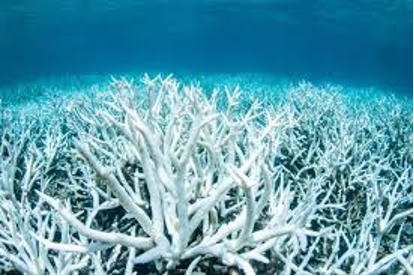
When Leilani was a child, the reef glowed like a city at night—neon parrotfish, blue starfish, coral that pulsed pink and gold. Now, at twenty-nine, she floats above it in silence.
White. Bone white. As if the sea had been boiled and drained of color.
Her oxygen bubbles rise too fast. The water is warmer than it should be. It always is now.
She surfaces near the canoe where her uncle waits, his skin weathered into a map of years spent fishing waters that no longer fish back.
“Anything?” he asks.
She shakes her head. “No recovery. The heatwave finished it.”
He nods, unsurprised. Grief here has become repetitive, almost procedural.
Back on shore, the village council meets beneath solar panels bolted onto a concrete schoolhouse roof—installed after the last cyclone tore through the island, stronger than any on record. The elders speak of leaving. Of New Zealand. Of Australia. Of becoming paperwork.
Leilani listens, thinking of the reef as it was, as she studied it in textbooks, as she documented its death for international databases that filled reports but never reversed trends.
That night, children gather around her laptop to watch old footage she archived years ago. The reef alive. Fish everywhere.
“Did it really look like that?” a boy asks.
“Yes,” she says. “And warmer oceans killed it.”
“Can it come back?”
She hesitates. Science says no. Not without cooling the planet. Not
without stopping emissions that continue, globally, despite promises.
“Only in stories,” she finally answers.
Later, she uploads her latest survey to a server thousands of miles away, powered by data centers she knows consume more energy than her entire island ever did.
Before sleeping, she records a final reminder in her field journal: 1.5 degrees was never safe. It was just the first lie we told ourselves.
| Prompts and Collaboration with ChatGPT |
|---|
In developing the stories, ChatGPT was most useful as a collaborative drafting tool rather than a replacement for my own writing. I gave it prompts that specified temperature thresholds, locations, and themes from the book, and then evaluated what it produced. Often, the first drafts leaned toward generality or over explanation. I learned quickly that meaningful cli-fi requires editing against that tendency, cutting down exposition and strengthening character perspective. The most successful moments came when I rewrote passages to emphasize emotion, silence, and moral tension rather than scientific description.
| Home | AI Writing | More Cli Fi Stories | About Us |