

|
|
| Last Chance Winter |
|---|
| Harrison Donaldson & ChatGPT |
|---|
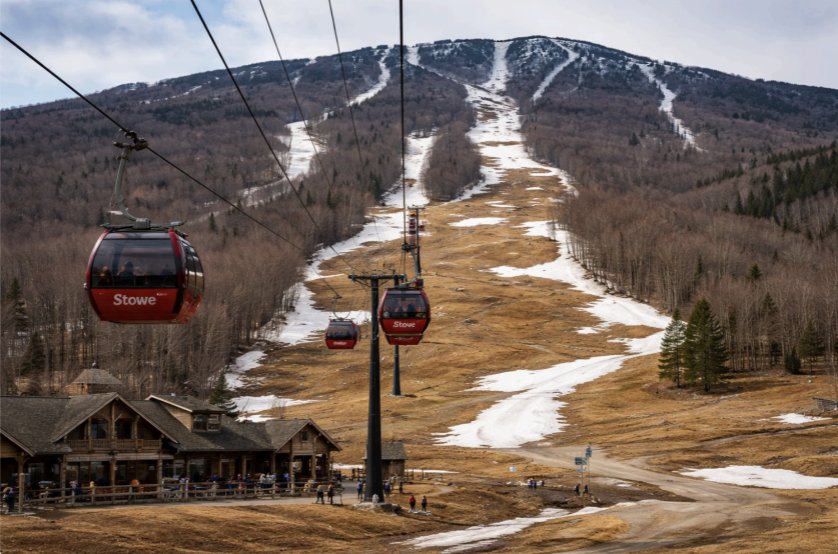
The first winter the mountains began to sweat, people in Stowe tried to pretend it was just a warm spell.
By the tenth winter, nobody pretended anymore.
The gondola cables hummed in the damp December air as Lena Ortiz, Director of Stowe’s Mountain Safety Team, watched bare streaks cut through Mount Mansfield’s slopes like scars. From the base lodge deck, tourists still snapped photos, careful to frame only the highest peaks where artificial snow clung in bright, unnatural strips.
The mountains looked sick.
Dark rock showed through where powder used to pile ten feet deep. Meltwater trickled down ski runs in thin, shining veins. The smell of wet soil — something that used to belong to April — hung in the air in early December.
“Snow report says seventy percent coverage,” said Mark Delaney, the resort operations manager, stepping beside her. He held a tablet like it might deliver better news if he stared long enough.
Lena didn’t look away from the slopes. “Snow machine coverage,” she said. “Not snow.”
Above them, compressors roared nonstop, forcing white ribbons across the mountain. But even the machines struggled. The temperature hovered just above freezing — too warm for good crystals, too cold for rain. The result was slush that skiers carved into gray paste by noon.
Still, tourists came.
Vermont, the quintessential American winter wonderland, including charming and cozy inns, like those in the snow-covered village of Stowe, once known for their world-class skiing. Visitors to Stowe could enjoy deep, snowpacked landscapes, outdoor activities like snowshoeing, ice skating, snow tubing, fat biking, and sleigh rides. The one ingredient defining Stowe’s tourism industry? Snow.
They always came — chasing memory more than snow.
Bing Crosby, in the 1954 movie “White Christmas” solidified winter tourism in Vermont, creating an indelible image visitors came to seek every holiday season - it was all about the white stuff. “It means we’re going to Vermont,” explained Crosby. “Might not be bad at that. The snow-covered slopes, the skiing. Christianas and the stemming and the platzing and the schussing. Hot buttered rum, light on the butter. And snow.” As Bing sings - “What is Christmas with no snow? No white Christmas with no snow.”
By New Year’s week, the crowds at Stowe were thicker than ever.
Climate anxiety had created a new kind of tourism: Last Chance Winter Travel. People flew in from Texas, Florida, even overseas, desperate to show their kids “real snow” before it disappeared completely.
Hotels overflowed. Lift lines stretched like summer theme parks. Rental shops ran out of boots by noon every day.
And the mountains kept melting.
One afternoon, a sheet of wet snow peeled off near the Chin like skin sliding off muscle. It didn’t fully avalanche — not yet — but the movement registered on monitoring sensors.
Lena’s radio crackled constantly now.
“Surface instability on Upper National.”
“Water pooling under snowpack at Toll Road crossing.”
“Ground heat readings are up again.”
The problem wasn’t just warmth. It was freeze-thaw chaos. Snow melted during the day, refroze weakly at night, then soaked again. The layers no longer bonded. The mountain was turning into a stacked deck of wet paper. Avalanche season, once a late-winter risk, had become all winter long.
The storm arrived in mid-January.
Not snow.
Rain.
Cold rain hammered the slopes for twelve straight hours, turning artificial snow into heavy slurry. Drainage systems overflowed. Small slides triggered overnight, blocking service roads and knocking out two lift towers.
But tourists were still on the mountain when the temperature finally dropped — suddenly, violently — as an Arctic front pushed south.
The rain froze where it lay.
Then six inches of dense snow fell on top.
Then another twelve.
The avalanche warning jumped to Extreme.
Lena stood in the emergency operations room at 5:12 a.m., staring at satellite slope scans. Red zones glowed across entire faces of Mansfield.
“This is bad,” Mark said quietly. S
he nodded. “If that top slab goes, it takes half the ski terrain with it.”
“And the gondola mid-station.”
“And anyone still up there.”
They tried to evacuate early.
Most tourists listened.
Some didn’t.
By noon, lift operations shut down. Buses lined up at base lodge. Families clutched hot chocolates and souvenir snow globes filled with plastic flakes that would probably outlast real snow in Vermont.
But then came the radio call.
“Trail patrol to base — we have stranded groups. Repeat, stranded groups. Three locations. Visibility is dropping.”
Wind screamed across the ridge. Snow blew sideways, erasing trail markers in minutes. GPS signals flickered in the storm.
Lena grabbed her rescue pack.
“I’m going up,” she said.
Mark started to protest — then stopped. Because they both knew she was the best avalanche tech left on staff.
Most others had moved west. Or north. Or quit entirely.
By the time Lena reached the first group — eight tourists huddled beside a snowmaking pipe — the mountain was groaning.
That was the only way she could describe it.
Low, shifting rumbles moved through the snowpack under her boots.
The mountains were melting. And freezing. And collapsing under their own confused seasons.
“Listen to me,” she told them, voice steady. “We’re moving now. Single file.
Step exactly where I step.”
A child started crying.
His father whispered, “Is the mountain breaking?”
Lena hesitated.
Then: “It’s changing.”
Halfway down, the slope cracked.
Not loud. Not dramatic. Just a deep, splitting sound — like a tree trunk tearing slowly apart.
She spun around.
High above, the snowfield shifted.
Then dropped.
The avalanche roared down the mountain in slow, horrifying mass — wet, heavy, unstoppable. It ripped snow guns from anchors. Lift towers bent like wire. Trees vanished in white-gray surge.
The ground shook.
Wind punched the group flat as the slide thundered past one ridge over, missing them by less than a football field.
When it finally stopped, silence swallowed the mountain.
That night, power flickered across Stowe.
News drones hovered over the damage. Social media filled with footage: broken lifts, scarred slopes, brown earth exposed in midwinter.
Tourists sat in hotel lobbies, waiting for buses that might not come until roads were cleared.
The ski resort and its slopes closed indefinitely.
Maybe permanently.
Weeks later, Lena stood at the base again.
Snow remained only in shaded pockets. Meltwater streams carved through ski runs. Moss and grass already showed through lower trails.
Tourism boards were rebranding. Emphasizing “mountain life” over “skiing”.
Stowe tourism leaders shifted their brand messaging from powdery slopes to alpine experiences, focusing on the scenic beauty, fresh air, and, in some cases, the "welcoming, spacious, and playful" atmosphere of the mountain resort.
Changed travel and tourist algorithms buzzed:
EcoTravel. Alpine Hiking. Climate & Sustainability Tours: Minimizing Your Ecological Footprint. Non-skiing, Nature-Focused Experiences.
People would still come.
They always came.
But winter — real winter — was becoming a story people told each other, like glaciers or passenger pigeons.
Lena looked up at Mount Mansfield, dark and exposed against a gray sky.
The mountain wasn’t dying.
It was becoming something else.
And whether people could survive loving it enough to let it change — that was the question nobody in Stowe could answer yet.
| Prompts and Collaboration with ChatGPT |
|---|
I started this story using prompts such as “vanishing snow”, “lost tourism”, and “climate anxiety” and, after editing some of the story for additional climate science impact, I gave ChatGPT the prompt: “Create a Cli-Fi Short Story (from third-person point of view) inspired by One Degree in Our Final Warning by Mark Lynas. Make it based on Tourism and Travel in Stowe, Vermont in the future, and involve the following elements in the story: Melting mountains, vanishing snow cover, avalanche threat and tourism.” I wanted to be as descriptive as possible, choosing an established and popular tourist destination as a relatable and specific setting.
| Home | AI Writing | More Cli Fi Stories | About Us |