
|
|
| Road Trip |
|---|
| Wesley Martin-Sharples |
|---|
Jamie woke earlier than he meant to, to the low voices emanating from the motel’s cheap TV. The room was awash in dim blue light, making the room like a dream he’d had once. He turned over in the bed to see what he already expected – his father, sitting on the edge of the opposite bed, frame slightly creaking as he adjusted his weight. He was staring at the screen intently, in the way his mom always chided him for because she was worried he was going to hurt his eyes. “You already need glasses,” she’d say, “you trying to go fully blind or something?” It was 5:38 in the morning, according to the alarm clock on the dresser, and despite the AC’s low thrum the room was still uncomfortably warm. He tilted his head slightly, not wanting to fully get up yet, and directed his attention to whatever news broadcast his dad was watching on the TV.
“…worst coastal flooding in United States history,” the news lady was saying. She seemed scared, Jamie noticed; not the calm, matter-of-fact voices he was used to. It sounded more like she was trying for that tone and failing miserably. She was gesturing towards bits of red along the edges of the country on a big screen behind her, as well as a couple more around the middle. “Anybody within a danger zone is advised to evacuate as soon as possible, and try to move more inland-“
The channel suddenly flickered to something else. Jamie glanced over at his dad, who was looking back at him sheepishly. His mom was always chiding him for that, too – telling him not to worry the kids with this stuff, despite the fact that Jamie had heard her crying too many nights to count lately. “Mornin’, kiddo.”
“G’morning,” he mumbled back. “What was that lady talking ‘bout?”
“Ah, y’know,” his dad sighed. “More floods, I guess. Something about ice caps and weather cycles…I dunno.” He coughed.
“It sounded bad,” Jamie swallowed. Mom was always telling him that it wasn’t so bad. “Think of it like a road trip,” she’d smiled at him then, that sweltering morning when they’d departed their old house with the peeling paint and shingled roof. They’d climbed into the old beat-up Range Rover and set out because of a broadcast a lot like that one, though they’d had to ditch the car after the roads got too crowded. They’d gotten lucky with the motel, at least – Dad had been worried it might be full up.
“It’ll be alright,” he reassured him. “Look, we’ll check out in an hour or so, and then we’ll find a place for us until things calm down. Sound good?” He leaned over to place a hand on Jamie’s shoulder, giving it a light squeeze. “Head back to bed, kiddo. Here, I’ll put something nicer on.” He flicked through the channels, finding some old cartoon Jamie had never seen before, and Jamie did as he was instructed and lay back down to make the most of his sleep while he still could.
Max watched his son settle back into bed and sighed. It wasn’t goddamn fair, he thought for what felt like the millionth time in the past week, and swallowed down what was either a swear or a sob. Here he was, a college graduate with a beautiful wife and a nice house, bright future ahead of him, and now he was lying in a crappy motel trying to dance around telling his kid that the world was probably ending. He’d done everything right – hell, he knew about all this climate change stuff in advance, gone to seminars about it. Yet he’d still had to watch as they got less and less snow each Christmas, until the magical blanket of white had shifted to the gray-brown color of dead grass. Still had to watch increasingly concerning news broadcasts – dust storms that had choked out refugees, wildfires that burned down the forests his buddies had gone camping in, coastal floods that displaced his family and who knows how many others. His kid would never know what waking up to a snow day felt like: he’d probably never even get to experience snow at all. That thought, of all things, made his chest tight.
He was spiraling again. He put his hands in his hair and took a deep breath: it’d be alright, he coped with himself. Things would calm down eventually, he just had to…stick it out. One day at a time, Max, come on. You got this.
At 7:02, Jamie felt a hand shake him awake. He peered up at his dad, squinting at the sunlight peeking through the blinds. His mom and sister were up too, he saw, packing their things and chattering about something he couldn’t hear. “C’mon, kiddo, time to go.”
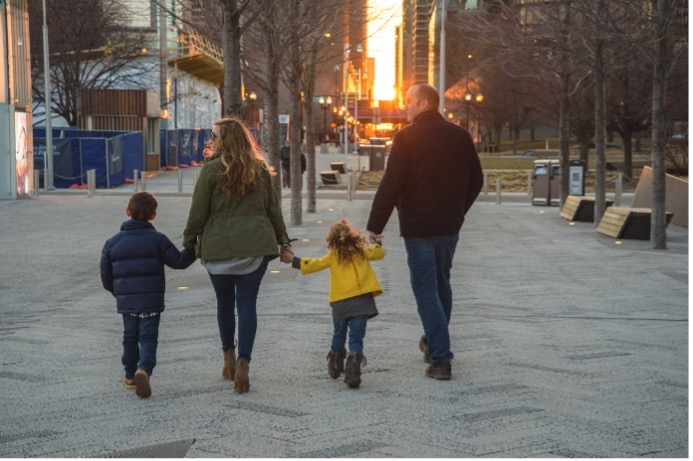
At 7:14, the Browne family was gathered in the lobby of the Castle Motel, shieled from the heat by a blasting AC, thin walls painted a sickly shade of green, and moth-eaten curtains drawn desperately across the windows to do whatever they could to block out the sun. Amelia glanced over at her husband checking out with the clerk, then turned to her children. “Everybody got their gear? Water, ice packs, sunscreen?” A tired chorus of “yes, Mom” met her ears, but she still took stock of her own bag, just in case. Plenty of water bottles left, a couple of already-melting ice packs, and a half-empty bottle of sunscreen. And Max used to rib her for overpacking, she thought. Look who’s laughing now, huh? Still not her.
At 7:18, they mentally prepared themselves, then stepped through the threshold into the humid February morning. None of them knew exactly where they were going, but Amelia had heard from a coworker when they first started preparing to move that there were shelters set up further inland for refugees. That had seemed as good a place to start as any, so inland they went, stopping at whatever motels or inns they could find that were still accepting people. It had been four days since they’d started, and two days since they’d ditched the car. Amelia was cursing herself for that, now – the roads had thinned out significantly now, and there were less people out and about than she was used to. She remembered early morning jogs, back when she’d enjoyed the breeze in her hair and the sight of the neighborhood waking up. Even back then, on the slowest mornings she could remember, there had been more people than this. Thinking about what had happened to those people was sobering.
The heat was an oppressive, all-consuming thing. It stole the breath from her lungs with each step, and beat down on her like a physical force. Her shirt clung uncomfortably to her back, and she had to wipe her forehead every few seconds. She felt like she was being smothered, and the worst part was she knew she had it easy. They were still in the Midwest, had migrated away from the Lakes and the forest fires. There were places around the equator that had become completely uninhabitable, according to Max.
As if he could feel her thinking about him, Max spoke. “I never thought I’d miss mosquitoes,” he pondered. Amelia snorted.
“You serious?”
“Sure,” he said lightly. “I mean, not really miss them, but…it feels weird to not have ‘em around, y’know? Like…” he huffed. “I always felt like they were a nuisance I was always gonna have to deal with. It feels wrong to not have to deal with ‘em now.”
Jamie listened quietly to his parents’ banter. They didn’t talk about their childhoods very much, but he knew from the snippets he’d heard that it’d been a lot different than his. They could camp in the woods without worrying about the smoke, gaze up at the stars without them being blocked out by smog! They’d even had something called snow – his dad had told him about it once, in a nostalgic tone. ‘A shining blanket of white,’ he’d called it with a sweeping gesture, and it had kept people inside because it was too cold. Tess, his sister, had shown Jamie old videos of it, and it looked as much like a fairy tale as it sounded. He wished he could see it for real.
They walked through the quiet streets for a while, stopping every so often to reapply sunscreen and sip from their water bottles. At around noon, they found an overpass, which they decided to sit under while they caught their breath and ate a small lunch. The shade didn’t provide much comfort from the heat, but it was marginally better at least. They were halfway through their lunch when Tess spoke up.
“I saw this thing on the news last night,” she started. “Apparently in…China, I think? They finished making this, like, dome. And it’s all air-conditioned and got lab-grown plants in it and stuff. We should make something like that.”
Max paused mid-chew. He had seen what she was talking about. And he had also seen the darker stuff – how the Dome was open only to the rich, how thousands of refugees crowded around it every day, how the ones that didn’t back off were shot. He swallowed. “That’d be nice. Maybe we’ll find something like that, hey?” He caught Amelia’s eye. The reminder of the Dome had ignited a worry that boiled in their guts like the temperature of the air: what if, like those outside the Dome, they were turned away at the shelter? What if something worse than being turned away happened to them at the shelter? Not for the first time, Max and Amelia wondered if there was a future for them. Max finished his grain bar, and started to say something else before coughing again. Amelia furrowed her brow. “Y’alright?”
“M’fine,” he sputtered. “Just – went down the wrong pipe, I guess.” He chuckled.
“If you say so…” That cough hadn’t gone away. She hoped he wasn’t coming down with something now: that’d be just their luck, at this point.
They picked up the pace after that. The atmosphere felt nervous, all of a sudden. There was something unspoken in the air, a reality that had suddenly come crashing down around them as the walls of hopeful optimism had begun to crack open. The kids could feel it, too, though they couldn’t put a name to it. They had stopped their idle conversations, just staring down at the pavement and putting one foot in front of the other.
The hours started to become a blur. When the sun finally, finally started to dip below the horizon, they began searching for a place to stay the night. Amelia had originally argued for walking at night, but Max had shot down the idea. The kids needed a proper sleep schedule, he argued, and besides, what’s going to be open at night? But now, that optimism felt silly to him. He had been working under the assumption that society could return to normal, that their children could have a future that he would need to prepare them for. Now, that future seemed a fleeting dream, melting before his eyes like first snowfall. They found a nearly-empty inn to spend the night in.
The streets they passed through were increasingly barren of life. They hadn’t seen a car in what felt like ages – nor an open store. They checked anyway, found some food, but all the bottled water had been bought up in a frenzy when all this started. It felt like one of the zombie movies Max had used to love, back when he was a kid, with the towns all abandoned after the outbreak. His cough was worsening, so he was trying to remember the happy times. Not valley sickness, he told himself. Just a cold.
They passed a dead dog, one day. Tess had cried. Amelia had thought of the stray dogs she’d used to pass scraps of food, and choked back a sob herself at the though of them.
When he wasn’t doubled over hacking, Max was checking his phone. He didn’t share anything with the kids, but what he told his wife was bleak. Crops were dying. Animals were going extinct. Sea levels were still rising, and more people were being displaced every day. Shelters were filling up, which was causing sickness to spread. The comparison to apocalypse flicks didn’t feel so funny anymore.
After another week of walking, they finally caught sight of the shelter – a squat, concrete building with an iron gate. It was flanked by makeshift guard towers, making it look more like a military base than a refuge. Despite their lack of supplies, despite the heat, despite the fear, despite everything, the Browne family caught their second wind and nearly ran to the spark of hope in the distance.
It was extinguished quickly.
“Two spots left,” the lady sitting outside at the old folding table had told them. Two of four. Max had argued, Amelia had cried, but it didn’t change anything. Two spots. And Max and Amelia knew exactly who was getting them.
Jamie hadn’t caught much of what his parents were arguing about with that lady, too distracted by something Tess was showing him on her phone. He was tired, his feet hurt, and he was uncomfortably hot. He wanted nothing more than to rest somewhere, somewhere permanent like his old house with the big backyard, when Max kneeled down in front of him and pulled him into a hug.
“Alright, kiddo,” he choked out, “you’re gonna stay here for a while, ‘kay? Mom and I are gonna stay somewhere else. We’ll check up on you, don’t worry.”
Jamie had mostly been annoyed and mildly anxious for the past week, but now he was scared. “Where are you going? What’s happening? Dad?”
“Mom and I will figure something out.” Jamie could barely hear him – he was looking over Max’s shoulder at Tess, who was crying in Amelia’s arms. “We’ll call you, okay? Be good for me. Hey-“ He suddenly pulled back, placing his hands on Jamie’s shoulders to look him in the eye. “I am so proud of you, kiddo. You know that? You are a kind, smart, brave kid, and you’re gonna do great things. I love you.”
Jamie, eyes blurred with tears, hugged his father for the last time. “I love you too, Dad.”
Max and Amelia watched as their kids were brought into the shelter. He was dying, and he knew it. She would probably follow suit, since they had given everything they had left to the kids. Given everything up for a future that was up in the sweltering air.
Max had no way of knowing for sure that the Earth would share his fate – as he choked on dust, the planet would choke on smog and heat, boiling the seas and scorching the fields. His kids might never grow up, get a nice job, find a partner, rent an apartment, adopt a pet, have kids of their own. He knew they would never see snow. Yet as stupid as he felt, and as he held his wife in his arms, he still hoped. Still hoped that his stupid, stubborn species would defy their self-destructive nature and hold out for a few more years. There would be no saving Earth, but he hoped his kids could at least survive. He looked up at the sun and wept.
| No AI! |
|---|
I decided not to use AI for this story. I have nothing against people who use AI – I just don’t personally feel good about using it. Given what we talked about in class about the environmental impact, data scraping, breach of privacy, and capacity for misinformation, it felt a little inappropriate to me. Plus, I felt like I could write a better story than the bot could (I hope I did, anyway).
| Home | AI Writing | More Cli Fi Stories | About Us |