
|
|
| Black Water |
|---|
| Tyler Geertz & ChatGPT |
|---|
They called it Anchorage, even though nothing truly anchored it anymore.
It started with three houseboats tied together after the floods took Baton Rouge. Then a fishing trawler joined. Then a barge. Then a ferry whose engines had burned out halfway upriver. Every new arrival brought people, and every group of people brought more structures—wooden walkways, welded frames, scavenged pontoons, plastic drums sealed with resin. Like the old floating villages of southern China, Anchorage grew sideways instead of upward. Markets formed in narrow corridors between hulls. Children learned to step from deck to deck before they learned to swim. If you stood still long enough, you could feel the entire town breathing beneath your feet.
Four degrees. That was what the scientists had warned about decades ago. Four degrees of warming, and everything would change.They were right.
The seas had risen faster than anyone predicted. Ice sheets collapsed. Storms grew wider and slower, dumping rain for days. Warm water killed coral reefs and rearranged entire fisheries. Algae blooms spread like stains across coastlines. Fish either migrated or died. Oxygen levels dropped. The food web unraveled from the bottom up.
Now people unraveled too. Every week, new boats arrived. Sometimes they were organized convoys, sometimes they were single families drifting on makeshift rafts. Anchorage took them all. That was the rule. No turning people away. But Anchorage was getting crowded.
Maya helped her mother repair fishing nets in the morning, though “fishing” was mostly a ritual now. They caught jellyfish sometimes. Invasive carp, occasionally. Mostly trash. “What did you get yesterday?” Maya asked her mom. Her mother shook her head.
Maya crossed the walkways toward the central market, balancing easily over swaying planks. Around her, Anchorage hummed with quiet activity. People patched hulls, sorted salvage, repaired solar panels. Kids carried buckets of graywater to the filtration rigs. An elder told stories about cities that didn’t float. She tried to imagine a world that stayed still.
Maya felt the shift in the air before anyone said anything. Pressure dropping. Wind changing direction. At noon, the warning flags went up. Red triangles unfurled from the tallest mast in Anchorage. Storm forming offshore.
By evening, the horizon had darkened into a solid wall. They’d ridden out storms before, Everyone had, But this one felt different. The council called for emergency tethering. Crews rushed to reinforce connections between platforms. Extra lines were run between larger vessels. Families secured loose structures. Solar arrays were folded down. Maya helped drag water barrels toward the center of Anchorage to stabilize weight distribution. “Too many people,” someone muttered nearby. No one argued.
The first waves arrived just after sunset. Not large yet—just heavy, rolling swells that lifted the town unevenly. Anchorage groaned as stress traveled through its framework. Somewhere metal screamed. Rain followed, sudden and dense. By the time the wind hit full force, visibility had dropped to almost nothing. Maya was with a tethering crew when a shock ran through the town. One of the outer platforms had broken free. She watched it drift away, lights bobbing wildly, people shouting from its deck.
Rope snapped. Someone fell into the water. Maya didn’t think twice. They threw lines. Pulled bodies back aboard. The sea tried to take them every step of the way. Anchorage twisted beneath their feet as waves climbed higher, smashing against hulls and tearing loose anything that wasn’t welded or tied down.
Over the radio came fragments of panicked voices. “Southern farms are flooding—”, “Generator three is down—”, “We’re losing section E—”. The town was coming apart.
Maya and her crew worked until her hands burned and her muscles shook. She helped brace a collapsing walkway with scavenged beams while rain stung her eyes. Around her, hundreds of people fought the same battle—holding their homes together with rope, faith, and exhaustion.
At the storm’s peak, a wave slammed into Anchorage hard enough to knock Maya flat. The impact stole the air from her lungs. She skidded across the soaked deck and collided with a storage crate, stars exploding behind her eyes. For a moment, all she could hear was wind and water and the distant sound of people shouting names. Then the structure beneath her shifted. Not swayed, Shifted. Maya pushed herself upright just as a violent tearing sound ripped through the rain. The deck she was on was lurched sideways, ropes snapping like gunshots. A jagged gap opened between her section and the rest of Anchorage.
Someone screamed.
Maya scrambled toward the fracture, reaching for a hand that vanished into the murky depths as another surge forced the two pieces apart violently. The gap widened instantly, black water boiling between them.
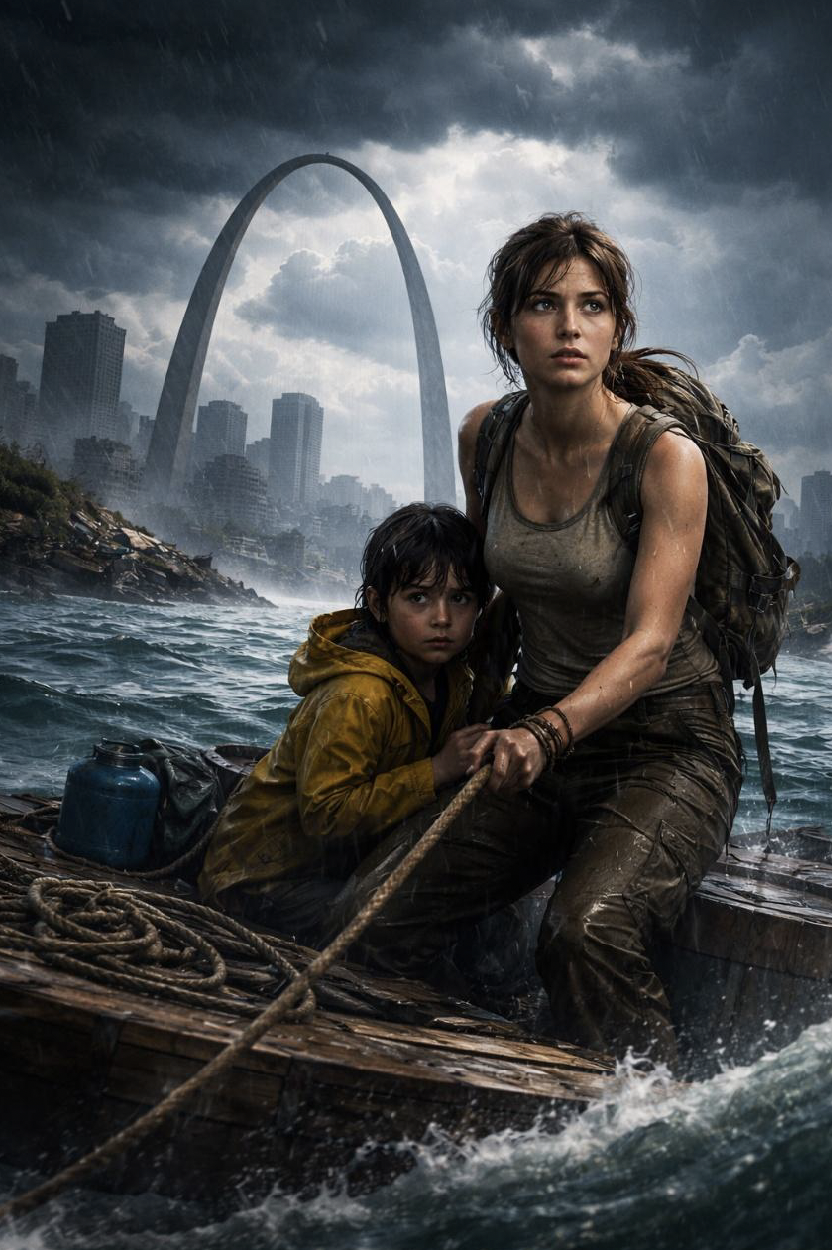
“Wait—!” she shouted, grabbing onto the railing barely keeping herself on board. Anchorage was already receding. Her section—part of an old ferry hull welded to several residential pontoons—spun slowly in the current. Three other people were with her: a kid she’d pulled from the flood earlier, an older woman clutching a medical pack, and a man from the tethering crew whose arm was bleeding through a torn sleeve. They watched in stunned silence as the town fractured.
Other clusters drifted away too, lights wobbling in the darkness like dying stars. Some vanished behind walls of rain. Others broke apart entirely, debris scattering across the waves. They were lucky to have ground to stand on. Anchorage was no longer a town. It was an archipelago of survivors. The kid pressed close to Maya, shaking, and she wrapped an arm around their shoulders. Hours passed in fragments. Rain softened. Wind eased. The waves shrank from walls into long rolling swells. By the time dawn arrived, the storm had moved on. What followed was worse.
The sky cleared into a pale, washed-out blue, and the sun rose without mercy. Almost immediately, the heat began to build. The air felt thick, heavy with humidity, pressing against Maya’s skin. Steam rose from every wet surface. Within an hour, everyone was sweating again, their soaked clothes turning into traps that held warmth close to their bodies. Four degrees of warming meant storms like that. But it also meant aftermaths like this. Hotter. Humid. Relentless.
The current was carrying them steadily east, out to open water. They rationed water immediately. The man—Evan—set up shade using torn tarps. The older woman, Rosa, cleaned his arm and checked the kid for shock. Maya scanned the horizon over and over, hoping to spot other survivors. They found none.
By midday, land began to appear. At first Maya thought it was another cloud bank, Then she recognized a shining, metallic curve. The St Louis Gateway Arch rose from the water like the spine of some enormous, drowned animal. Only the upper third remained visible. The sun reflected off the metal, concentrating the rays into a powerful beam that boiled any water in its path. The city that was once surrounded by parks, museums, and riverwalks, was gone beneath a broad, shimmering inland sea. The Mississippi had expanded far beyond its historic banks, merging with floodwaters from a dozen drowned tributaries. Former streets lay invisible beneath the surface. Submerged buildings formed dark shapes below the ripples.
A few landmarks still pierced the water. The tops of old office towers. A fragment of a stadium roof. Rusting light poles leaning at strange angles. They drifted closer in silence. Heat radiated off the exposed steel of the Arch, warping the air above it. The sun reflected off the flooded city in blinding sheets, making Maya squint. There was no breeze now, only stagnant warmth and the distant buzzing of insects that had adapted to this new wet world.
Algae slicks floated in greenish patches across the surface. Dead fish bobbed occasionally into view, victims of low oxygen zones and overheated water. The smell was faint but unmistakable—sweet decay mixed with oil and plastic.
“This used to be dry,” Rosa said quietly. Maya nodded. She’d seen pictures once. Families posing at the base of the Arch. Tour boats on a narrow river. Now the monument stood in the middle of an inland bay. They guided their drifting platform toward one of the Arch’s exposed maintenance ledges and managed to tie off. From there, Maya climbed higher, carefully making her way along sun-warmed metal until she could look out across what had once been St. Louis.
It was almost beautiful, in a terrible way. Water stretched to the horizon, broken only by scattered rooftops and skeletal trees. Heat shimmered across the surface, bending the air itself. The clouds were gone entirely, burned away by rising temperatures. The city had become a shallow sea dotted with ghosts. Maya shaded her eyes and searched the city for movement. There was nothing.
She climbed to the very peak of the arch and sat, feeling the heated metal press through her clothes. For once, there was no rocking beneath her, no slap of waves against hulls. Only stillness. She looked down at her dangling legs and the two-hundred-foot drop below, the water glinting far beneath.
Despite everything that had brought her here, Maya let herself pause. For a moment, she was quiet.
It was her first time on solid ground.
| Prompts and Collaboration with ChatGPT |
|---|
To get this story I had to generate several large paragraphs of text. They never ended how I wanted as GPT always wanted a happy ending, so I would tell them where to continue from with a new direction in the story that I wanted them to follow. This only took a few attempts, and I believe it’s a solid story. The characters are not the main focus since ChatGPT is not very emotional, so the focus was on the action and survival aspects.
| Home | AI Writing | More Cli Fi Stories | About Us |