
|
|
| Not Far Enough |
|---|
| Gianni Laudadio & ChatGPT |
|---|
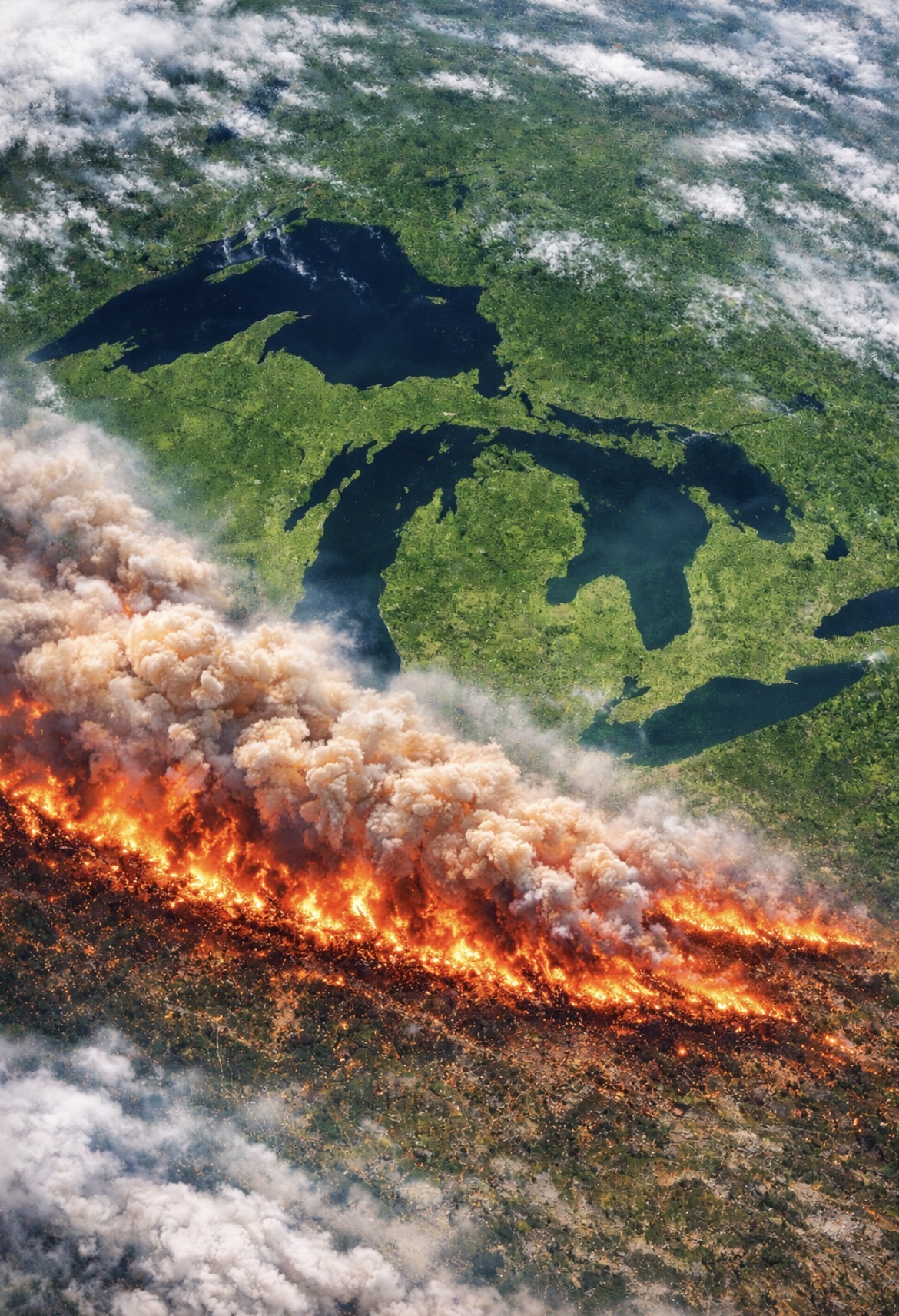
During the end of the 2020s, while most countries were making strides towards their ambitious goals of net 0 carbon emissions by 2050, occurred a tipping point. The increase in energy demand sparked by the construction of massive data centers, strained power grids, and an unexpected global population spike caused an invisible “point of no return” to be crossed.. At this point a 2 degree world by the end of the century was virtually unavoidable, but unknowingly, before this invisible moment, society could have still narrowly avoided its now unavoidable decline. Positive feedback loops set in motion by the Amazon forest fires of 2029, which saw 80 percent of the Amazon rainforest turned to ash were now spiraling beyond the reach of human control. At this point, atmospheric CO2 levels had surged towards 600ppm by the time the fires had ceased. A number far higher than estimated by climate models of the pre 2 degree world.
In the United States, desertification had overtaken most of the west and mass migration north and east from places like southern California, Arizona and Texas caused a higher percentage of the American population to reside east of the Mississippi River than before the gold rush of the mid 1800s. As much as 90 percent of the country now lived east of the Mississippi with a few coastal pacific northwest cities like Seattle and Portland housing up to 2 thirds of all western Americans. The climate of Chicago now more resembled Kansas City with dry, hot summers and mild winters. Michigan now resembled modern day South Carolina with Lake Michigan's summer temperatures reaching as high as 90 degrees, fueling lake effect precipitation more than twice the state’s yearly average pre year 2000. Most importantly, the climate of southern Ontario closely resembled the climate of early century southern Michigan or Northwest Indiana with higher precipitation averages along eastern shores of the Great Lakes, but warm summers and cold winters.
A couple, nervous about overpopulation of climate refugees from the west and south, decreasing crop yields and increasing pollution levels decided to abandon their lives in southern Michigan and head north. Their plan was to spend all of their savings and purchase a large chunk of undeveloped land in the Algoma district, along the northeastern shore of Lake Superior. The rocky, mountainous terrain made most of the region unsuitable for industry and agriculture and much of it remained undeveloped, aside from a few small mining towns along the lake’s eastern shores. Their property however included a small sliver of lakefront at the mouth of a small Ephemeral creek south of the White River. The base of this creekmouth held fertile soil rich in nutrients as snowmelt and precipitation runoff flowed down the mountains towards the lake, picking up nutrients on the way. There was nothing but an ATV trail leading to the property with no electricity, running water, or gas. Their plan was to essentially go off grid, spending long periods of time on the property between venturing into town for occasional supplies and fuel. It wasn't much, but it seemed to be enough to escape the global meltdown they were certain was looming.
By 2050, they had established themselves on the property, often spending the entire months of January and February without leaving to gather supplies. They had gained what seemed like a lifetime of ecological intelligence and experience in their first decade on the land. Although complete disconnection proved more difficult than initially anticipated, it transformed them into people of the land in a time where it seemed most were at the bane of the natural world, seeing it as an enemy and spending their whole lives running from its discomforts. They had a small farm with basic vegetables and a yield good enough to turn profit each fall while still maintaining a healthy reserve for the winter. Most of their income came from an apple orchard on the foothill of a mountain in the back of their property. They had planted the trees throughout the early 2030s and now they supplied a fruitful yield each fall in a world where apples were becoming increasingly difficult to grow due to erratic late season frosts in latitudes further south. They had 2 young children who at the ages of 5 and 7 were beginning to learn the ways of the land. They hoped their children would gain even more knowledge than they and felt they had done well to set their children up for a life free of toil as most of the world began falling to civil wars, famine, floods, and drought.
Though they had no electricity, they paid a professor at a university in the United States to mail them a short brochure of the most important global news, including climate data, wars, technological advances and more every month or so. Aside from a weather radio, and some books they were able to purchase when in town, this was their only contact with society.
By 2070, their kids had taken the reins. The couple themselves now worked mostly on smaller tasks around the house while the kids took care of most farm related business. At this point, the global climate was 3 degrees above historical averages and warming fast. The Antarctic was ice free 9 of 10 summers and the Greenland ice sheet was collapsing fast. Climate refugees had reached over 1 billion as large portions of the globe began to turn to desert. Food scarcity remained the main problem and fueled wars across the globe. However, they remained confident that they and their children were safe. The eastern shore of Lake Superior had still remained undeveloped despite the industrialization of Michigan's upper peninsula and a 10 fold population spike in Duluth, Minnesota on the lake’s western end.
By the year 2080, both had grown old and were approaching the natural end of their lives. Decades of work had taken their toll and they were now beginning to slow down mentally as well. Just as they had hoped, their children had become more knowledgeable than they had even imagined and now were making enough money off their land to sustain themselves more than comfortably. However, tensions were rising in the south and northward migration was beginning to threaten the still pristine Algoma district. Logging technology had developed to a point where mountainous terrain no longer presented a hurdle, and lumber had been an ever more valuable resource as deposits of other materials had been exhausted. As historically populated regions of the mid latitudes searched for their forgotten climate and shifted north, the Canadian border was overrun. With appearingly inexhaustible reserves of lumber and freshwater, Canada began to experience mass immigration so large that it could not be controlled by governmental forces. The year of 2079 would go on to be known as the “Great Canadian collapse” as wealthy Canadian landowners and the Canadian government alike sold off massive chunks of wilderness to a few wealthy enterprises for what they began to call the “development of the new world” this large scale invasion of the Canadian north would closely resemble the nearly forgotten invasion of the United States as natives were violently displaced and forced by the new government to congregate in reserves around the country.
The end was nearing and they soon began to realize that the toil they had spent their whole life seeking avoiding was now due to catch up with their children soon after they departed. They had once thought their children would be among the last who didn't have to worry about climate induced chaos, but now their future began to appear grim. Many plants and animals had gone extinct in their northward stretch as they couldn't move north enough, fast enough to survive. Now, with wildfire smoke dimming, the winter sunset in the southwestern sky, it seemed they, too, had not gone far enough.
| No AI! |
|---|
As for AI usage, I didn’t use it at all while writing but used it to generate the image.
| Home | AI Writing | More Cli Fi Stories | About Us |