
|
|
| The Heat Shift |
|---|
| Damon Llerena & ChatGPT |
|---|
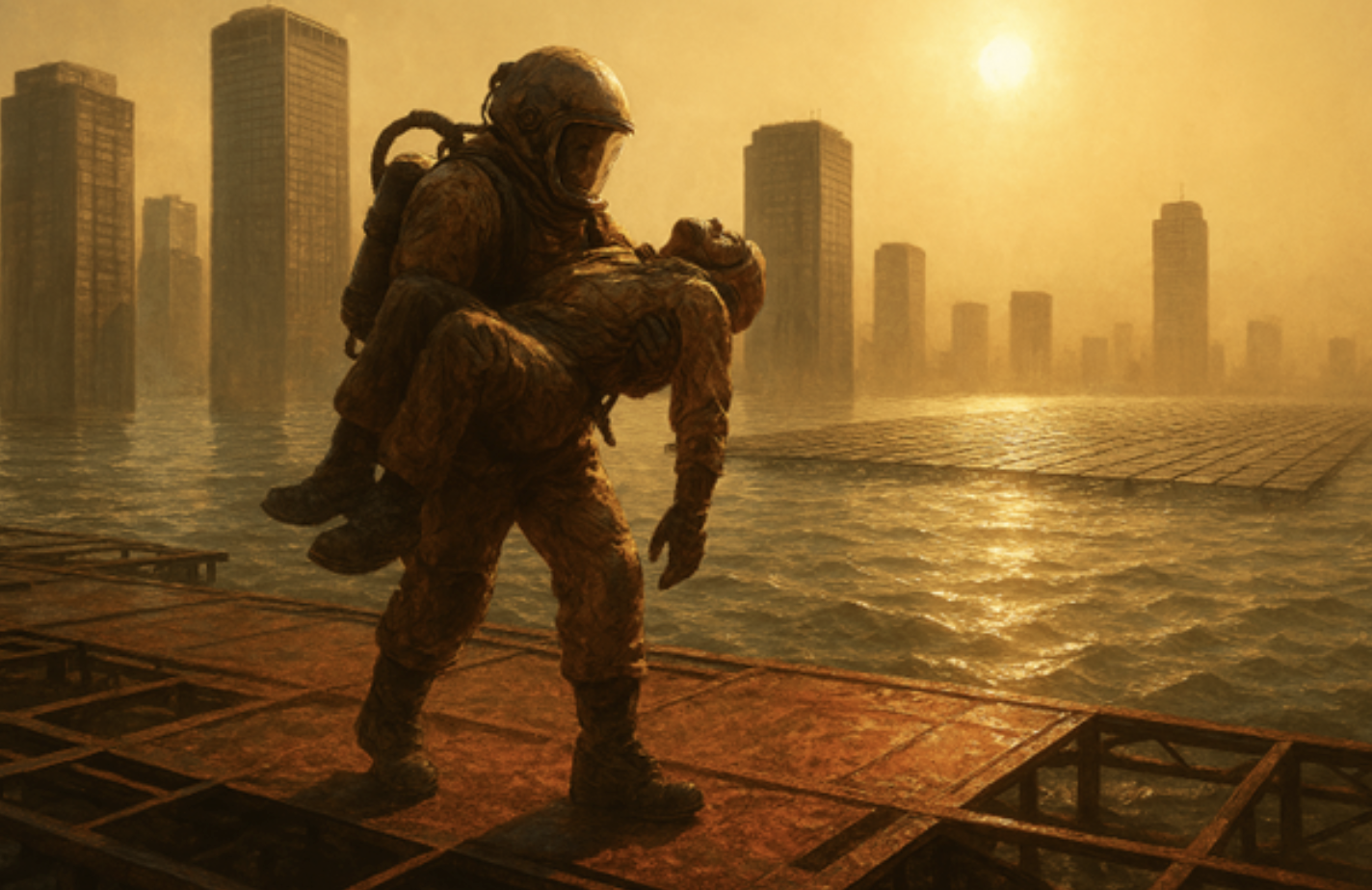
By 2095, the city once called New Orleans was known simply as The Basin. The sea had swallowed the old neighborhoods long ago, leaving only the elevated districts and the corporate towers that rose above the water like polished monuments to denial. Everything below the seawall was a maze of stilt platforms, floating markets, and rusted walkways that groaned under the weight of the heat.
At 4°C of global warming, the air itself felt hostile. Wet‑bulb temperatures hovered near the edge of human survivability. People didn’t talk about “summer” anymore — they talked about “the season of caution,” when stepping outside without cooling gear was a gamble with your life.
Jax didn’t own a cooling suit. He rented his from HelioCorp, the same company that paid him to maintain the offshore solar arrays. The suit was old, patched, and prone to overheating. But it kept him alive. Most days.
He stood in line at the dock before sunrise, the humidity clinging to his skin like a second layer. A woman behind him coughed — a deep, rattling sound that came from years of breathing superheated air.
“Another red‑alert day,” she muttered.
Jax nodded. Red‑alert meant the heat index was so extreme that HelioCorp required workers to sign an additional liability waiver. If you collapsed on the job, they weren’t responsible. They never were.
The shift boat arrived, its hull scorched from decades of relentless sun. Jax boarded with the others, the deck vibrating beneath his boots. The foreman — a tall man with a cooling suit far nicer than theirs — barked orders.
“Array 17 is down again. Corporate wants it online by noon. Move fast.”
Jax exchanged a look with his friend Mateo. Noon was suicide. But refusing meant losing the suit rental — and without the suit, you couldn’t work anywhere.
The boat cut across the water, passing the skeletal remains of skyscrapers half‑submerged. Pelicans perched on rusted balconies. The world felt like a graveyard.
Array 17 loomed ahead: a massive field of solar mirrors floating on pontoons. Half the mirrors were tilted wrong, reflecting sunlight into the sky instead of the collectors.
“Storm surge must’ve hit it last night,” Mateo said.
Storms were constant now. The Gulf was a warm bath, feeding hurricanes that formed in hours instead of days.
They climbed onto the array. The metal was already hot enough to burn through gloves. Jax’s suit whirred, struggling to keep his core temperature stable.
They worked quickly, adjusting mirror angles, tightening bolts, resetting sensors. Sweat pooled inside Jax’s helmet. His vision blurred.
“Break,” Mateo said, touching his arm.
Jax shook his head. “We won’t make quota.”
Mateo hesitated, then nodded. They kept going.
By mid‑morning, the sun was brutal. The horizon shimmered. The air felt thick, like breathing through a wet cloth. Jax’s suit alarm beeped — CORE TEMP RISING.
He ignored it.
Then he heard a crack — metal giving way. A pontoon had split under the heat, sending a section of mirrors tilting dangerously.
“Move!” Mateo shouted.
Jax jumped back as a mirror panel crashed into the water, sending up a spray of steam. The heat was so intense the droplets evaporated before they hit the deck.
The foreman’s voice crackled over the comms. “Keep working. We need that array online.”
Mateo cursed. “They don’t care if we die.”
Jax didn’t respond. He already knew.
Minutes later, Mateo collapsed. His suit alarm screamed. Jax dropped to his knees beside him.
“Stay with me,” Jax said, fumbling for the emergency coolant injector.
Mateo’s eyes fluttered. “It’s too hot,” he whispered.
Jax injected the coolant, but the suit was too far gone. The heat had overwhelmed it.
The foreman’s voice came again. “If he’s down, tag him and keep working.”
Jax froze. Tag him. Like equipment.
He looked at Mateo — his friend, the man who shared ration packs with him, who joked about leaving The Basin someday even though they both knew they never would.
Jax stood slowly. “We’re done,” he said into the comm.
“Repeat that?” the foreman snapped.
“We’re done,” Jax said again. “Shut the array down. Pull the shift.”
A long silence.
Then: “If you leave that array offline, you forfeit your suit rental. Effective immediately.”
Jax looked at Mateo’s still body. He looked at the boiling horizon. He looked at the mirrors, gleaming like knives.
“Then come take it,” he said.
He lifted Mateo into his arms. The suit groaned under the weight, but Jax didn’t stop. He walked back toward the dock, each step a refusal.
Behind him, the array shimmered in the heat — a monument to a world that had traded human life for energy.
And for the first time, Jax didn’t feel afraid.
He felt angry.
| Prompts and Collaboration with ChatGPT |
|---|
I used AI as a collaborative tool to help me draft and refine this story, starting from the science and scenarios in Mark Lynas’ Our Final Warning. I guided the tone, themes, and focus on labor, heat, and corporate power, while the AI helped generate variations in description, pacing, and structure. I made the final choices about what to keep, what to cut, and how to shape the emotional arc so the story felt grounded, human, and connected to real climate futures.
| Home | AI Writing | More Cli Fi Stories | About Us |