
|
|
| The Dying Phoenix |
|---|
| Garrett Finley & LLM Gemini |
|---|
The shimmering heat haze distorting the skyline of Phoenix wasn’t just weather anymore; it was a permanent state of being. Leo pressed his forehead against the triple-paned glass of their thirty-fourth-floor apartment, watching the dust devils dance across the abandoned highway below. At 4°C of warming, the city had ceased to be a place where people lived in; it was a place they hid under.
"Leo, check the credits again," his mother called out from the kitchen. Her voice was thin, strained. She was measuring water into a cup with a terrifying precision, terrified of spilling a drop.
Leo tapped his wrist comm. "We’re at 72% for the month, Mom. And it’s only the 14th."
This was life in the "Four Degree World," as the history vids called it. The Southwestern United States had been swallowed by a permanent "megadrought," a climatic shift that scientists had warned was a near-100% certainty. The Colorado River, once the lifeline of the West, was a memory, its headwaters dried up as the snowpack in the mountains vanished. Now, the city survived on recycled sweat, expensive desalination piped from the dying oceans, and hope—though the price of hope was rising faster than the water credits.
"We can't afford a refill until Friday," his mother sighed, capping the jug. "We’ll have to skip the shower cycle. Again."
Leo nodded. He didn’t mind the smell; everyone smelled like recycled air and stale anxiety these days. He was more worried about his father. From the back room came the dry, hacking cough that had become the soundtrack of their lives. It was Valley Fever. The fungal infection, caused by spores lifted from the parched desert soils, had surged as dust storms became more frequent and intense. With the drying of the land, the dust had nowhere to settle, and the sickness had spread all the way to the Canadian border.
"I'm going to the distro-center," Leo said suddenly. "They might have an override voucher for families with medical flags."
"It's unsafe, Leo," his mom said, eyes widening. "The index is critical today."
"I'll take the tunnels. I'll be fast."
He didn’t wait for permission. He pulled on his cooling vest—a heavy, gel-filled contraption that bought you about forty minutes of survival outside the climate-controlled zones—and grabbed his filtration mask. In a world where temperatures regularly exceeded the old Death Valley records of 43°C (110°F), stepping outside unprotected wasn't just uncomfortable; it was lethal.
Leo stepped out of the building's airlock and into the "pedway," a covered, elevated tunnel system that connected the city’s hab-blocks. The air here was hot, despite the shielding, but it was breathable. Through the scratched plastic walls, he looked out at the city. It was a ghost town of concrete and glass. The streets below were empty. At this level of warming, the "survivability threshold" was crossed regularly, meaning a human being, no matter how fit, could die from heatstroke just by sitting in the shade.
He reached the distribution center, a fortress of reinforced steel. The line was short; people didn’t venture out unless they were desperate. A screen above the counter flashed the daily stats: Current Temp: 46°C. Humidity: 12%. Dust Warning: High.
"Medical override," Leo rasped to the clerk behind the plexiglass, sliding his dad’s ID under the slot.
The clerk looked tired. Everyone looked tired. "System's lagging. The heat mess with the grid again. You know the rules, kid. If the power goes, the pumps stop."
That was the nightmare scenario. In these glass towers, a power outage meant the artificial cooling stopped. Within hours, the buildings would turn into solar ovens, cooking the millions trapped inside."
Just a few liters," Leo pleaded. "He's coughing up dust."
The clerk sighed and punched a code. "Take it. But hurry back. Weather Service pinged a haboob incoming."
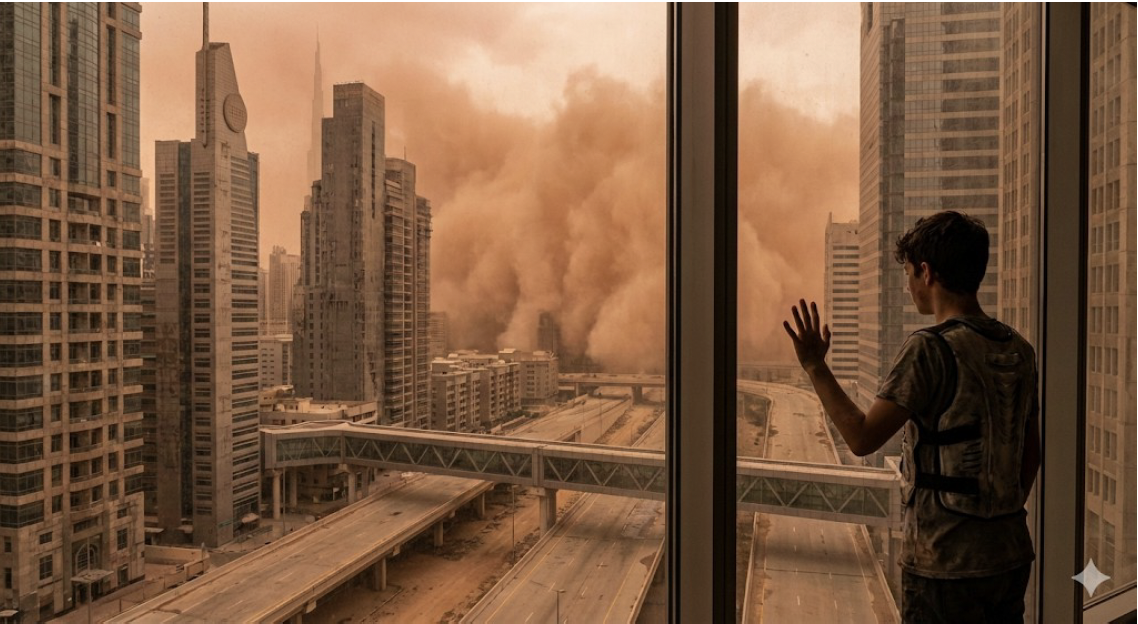
Leo grabbed the heavy canister of water and ran. The weight dragged at his shoulders, but the fear drove him faster. A haboob—a giant wall of dust—wasn't just a storm anymore. In the four-degree world, the landscape had been stripped of vegetation by drought and fire, turning the soil loose. These storms were monsters, towering clouds of red earth that choked filters and buried entire neighborhoods.
He was halfway home when the sky turned a bruised purple. The light in the pedway dimmed. Leo looked to his left and saw it: a mountain of darkness swallowing the skyscrapers downtown. The dust storm.
He sprinted, the cooling vest heavy and hot against his chest. His breath roared in his mask. The wind hit the pedway structure, making the plastic walls groan. If the seal broke, the spores would get in. The dust would get in. The heat would get in.
He slammed his hand on the keypad of his building's airlock just as the world outside went pitch black. The door hissed open, and he tumbled into the cool, sterile safety of the lobby.
Upstairs, he found his mother sitting by his father’s bed, holding his hand. The coughing had subsided for a moment. Leo set the canister down on the table with a heavy thud.
"I got it," he whispered, peeling off his mask. His face was pale, lined with sweat.
His mother looked at the water, then at the window. Outside, nothing was visible but a swirling wall of red. The city lights were gone. The sun was gone.
"They say the drought might break next year," his father wheezed, his voice dry as the desert. "Maybe the rains will come."
Leo looked at the water credits on his wrist, then at the terrifying storm raging against the glass. He knew the truth, the one the history books had written years ago. The jet streams had shifted. The moisture was gone. In this new world, survival wasn't about waiting for the rain; it was about enduring the dust.
"Drink, Dad," Leo said, pouring a glass. "Just drink."
| Prompts and Collaboration with ChatGPT |
|---|
I worked with the LLM Gemini, by Google, and had it parse the contents of the book Our Final Warning by Mark Lynas in order to get an accurate context of the kind of world events that may be taking place at different temperature levels of global warming. I noticed the book details mega-droughts throughout southwestern United States at the four degree increase in global temperatures and selected a city that would make for a good setting. I wanted the story to have a dystopian almost post-apocalyptic feel and Gemini expanded upon that by incorporating the water credit system discussed in the story.
I gave the AI a bit of an idea of the main premise I wanted it to focus on by instructing it to focus on a teenager living in the city with his family and their struggled with the severe water shortage their region is facing and how it is especially affecting them while living in a densely populated city. I was impressed with the content of the story that the AI created and filled in the gaps in my initial story setting by creating the system of water tokens each month for family in the city and creating the main problem that main character faces with his father being sick and the need for more water in order to help.
| Home | AI Writing | More Cli Fi Stories | About Us |