
|
|
| The World That Remained |
|---|
| Elise Ciciura & ChatGPT |
|---|
I was alive when money stopped working. First it failed in places that had always been considered expendable. Then it worked only for transactions that no longer mattered. Eventually, it became an object people kept in the way they kept photographs, evidence that there had once been a system where survival could be postponed.
For some, the world had been much easier when money still worked. Money brought the convenience of distance from things like thirst. Money had allowed them to live without knowing where food came from, how water moved, or what heat did to a body over time. When the illusion of that green paper disappeared, some of them did too. A number of people chose to leave early, quietly. This was noted without judgment. It was strange to remember that people had once ended their lives because they lacked money, while now others did so because it no longer mattered.
For others, the shift was different. People who had struggled under the old system—those who had never trusted paper to begin with—adapted more easily. Farmers, laborers, mechanics, those who knew soil and water and weather without language for it. Their knowledge, once dismissed as unskilled or backward, became essential and respect reorganized itself around usefulness, not accumulation. The person who mattered during drought was useless during migration. The one who knew how to build shade had nothing to offer when illness spread.
What remained were arrangements. Most people lived in groups small enough to move. Permanent structures were rare and simple, built for shade first, storage second while anything that required constant cooling or frequent repair was abandoned early. The heat punished ambition more than poverty.
Movement followed temperature gradients the way herds once followed rain. People learned their own tolerances the way they learned those of lizards or birds — how long skin could hold heat, when cognition dulled, when thirst distorted judgment. The difference between human planning and animal response became difficult to locate.
People stopped describing this shift in ideological terms. No one gathered to declare it adaptation or loss. It appeared instead in posture — in how heads tilted toward wind direction, how rest occurred without guilt, how attention fixed itself to shade lines and water weight rather than possibility.
There were no fields in the old sense. Food grew in scattered plots where shade and water briefly overlapped, and nothing was irrigated continuously. Water was too unstable for that. It was given in short intervals, just enough to keep roots alive. Many seasons, planting wasn’t worth the loss, so seeds were saved instead with hopes of rain the next year.
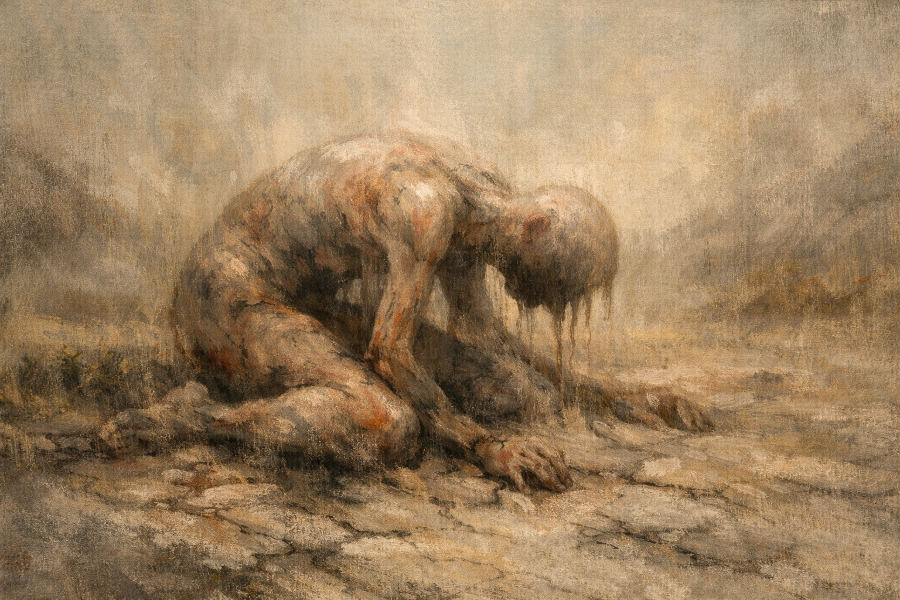
During the day, people stayed still in buildings hollowed from earth and stone—dark, low, and narrow like the burrows of desert creatures. Sweat dried on motionless limbs as bodies rested in the dim coolness, not from choice but necessity. Even minor exertion could trigger cascading symptoms: first the dizziness, then the nausea, finally the fever that would cook the brain from within. Illness came quickly in the heat—a punishment for momentary carelessness—and took longer to leave, lingering in joints and lungs for weeks after the initial collapse.
The concept of building for the future had vanished. Construction now served only present needs—a tarp for shade during this afternoon's peak heat, a basin to catch morning condensation, a sharpened edge to process what had just been caught. When shelter gave way or water collection systems broke, the consequences manifested in immediate bodily suffering. Nothing buffered failure from its effects.
"What do you do?" became a question without meaning. Instead: "Where did you last find moisture?" "Which seeds sprouted?" "Who's still missing after yesterday's temperature spike?" Starvation was no longer theoretical or distant. Without warehouses of surplus, government reserves, international aid, or the ability to borrow against future harvests, hunger became as immediate as thirst.
This shift did not breed virtue. It bred vigilance. Attention replaced ambition as the central organizing principle. Instead of plotting toward distant possibilities, minds curved inward toward immediate parameters — how many hours until peak heat, how far to the nearest water, how much remained in the clay vessels. Human thought no longer imposed itself upon the world but moved within it, less like architects drafting blueprints and more like roots seeking moisture.
No one could predict the storms anymore. Entire seasons might pass without a drop. Then suddenly the sky would split open, releasing torrents of bathwater-warm rain that carved new channels through the land before vanishing. Within a day, only damp shadows remained where floods had been. We followed these traces with our fingers, with our tools.
Along these temporary watermarks, we scored the earth and pressed in sorghum seeds—not in the grid patterns of the old world, but in meandering lines that honored the water's path. Sometimes the next rain washed everything away. Sometimes the heat baked the seedlings to dust. We stopped counting bushels and started counting survivors—the ones that managed to drop seeds before dying.
I recall the climate summits, the boardroom tables where we sat in our breathable fabrics while outside the mercury climbed past 40°C. We still had air conditioning then. We still had quarterly reports and five-year plans.
The PowerPoints glowed with colored graphs—red lines climbing, blue lines descending. Someone always brought up carbon capture. Someone always mentioned nuclear. We drank water from plastic bottles while debating water futures.
None of us suggested abandoning the cities. None of us imagined unplugging the grid. We never considered that survival might require dissolution rather than reinforcement. The word "civilization" appeared in every mission statement, underlined, unquestioned.
We measured success by how much we could preserve—how many coastal properties could be protected, how many supply chains maintained. We believed we could trim the edges of consumption without addressing its center. We thought we could keep everything we loved if we just made better choices about how to power it.
From this vantage, what once seemed like opposite poles revealed themselves as neighboring points on the same sphere. The climate engineers with their carbon capture dreams and the deniers with their economic forecasts had been twins all along, each refusing to consider that human dominance might simply end. One group built seawalls while the other built investment portfolios.
I remember how they shouted across conference tables, how they cited competing datasets, drafted opposing legislation. Yet both clutched the same assumption: that humans would continue to command Earth's systems rather than be commanded by them.
Neither could conceive of surrender as wisdom. Neither imagined adaptation might mean becoming smaller, less significant, more animal. When the abstractions they depended on—global supply chains, financial instruments, digital networks—finally collapsed under heat stress, their argument evaporated with the last air-conditioned rooms.
I spent decades with muscles tensed, scanning headlines for hidden agendas, dissecting corporate statements for what they concealed, measuring the gap between climate promises and their implementation. My body knew no other posture than braced vigilance.
Then, as systems collapsed, that tension released—not into safety but into a simpler relationship with threat. Danger remained immediate and physical, but it no longer arrived disguised as progress, wrapped in quarterly reports or development initiatives.
My shoulders dropped. My jaw unclenched. The mental gymnastics of parsing institutional doublespeak became unnecessary when institutions themselves dissolved. What I felt wasn't triumph over the systems I'd once fought, but the quiet exhale of no longer needing to fight them. Birth rates fell, not from hopelessness but from understanding. People once created children as if their existence guaranteed a future that would welcome them.
Schools had existed before—vast structures containing young bodies for hours beneath artificial light. Concrete yards with manufactured shade. Taps that poured clean water endlessly. Centers for the very young where temperature never varied, meals appeared regularly, and medicine stood ready. The entire architecture of childhood had presumed that larger structures would shield the young from consequence.
Those structures dissolved.
When buildings became heat traps and water sources failed, childhood itself became impossible to maintain as a protected category. The places where learning had been formalized stood empty. The rhythms that had organized young lives disintegrated. The unspoken contract—that the world would hold steady long enough for a child to mature within it—had been irreparably broken.
Parenthood stopped being framed as duty, legacy, or resistance. Reproduction stopped being discussed as a choice or a statement. It settled into timing instead — into the precise shade of yellow in a woman's eyes indicating sufficient vitamin stores, into the measured depth of water cisterns after the winter rains, into the density of shade cast by the settlement's lone surviving mesquite tree at midday, and into the callused hands of others who might help deliver and raise what came. People watched themselves the way they watched the desert tortoises emerging from estivation or the rare night-blooming cacti: with patient attention to subtle signs, waiting for the precise alignment of conditions or recognizing, with neither grief nor relief, when it would not come.
No one called this regression. No one called it wisdom. It was simply the reappearance of a logic that had never actually left, like ancient riverbed patterns revealing themselves again in the dust after wind storms.
Most people answered that unspoken question quietly and chose restraint, their bodies making decisions their minds merely witnessed.
The human herd thinned naturally. Where death once summoned paperwork and ceremony, now it passed like weather. The old bureaucracies—those systems of counting and accounting for each person—had dried up like the reservoirs.
When someone was gone, their knife found a new hand. Their sleeping corner housed someone else. Their name stopped being spoken, not from disrespect but practicality. When a settlement could no longer sustain its few, they drifted toward other hearths or deeper into the wilderness, following instincts older than language.
No one gathered to plan reconstruction. The very concept belonged to a time when humans believed in permanence, when coordination across distance seemed possible. What remained simply contracted, like skin around a wound.
Memory shortened. So did the desperate human need to be witnessed, to leave marks that outlasted flesh.
By then, the habit of ranking had withered away. No one spoke of humanity's former glories or failures, nor did they place themselves above or below the lizards that shared their shade. All living things now performed the same essential work—converting sunlight to movement, holding moisture in cells, finding paths across the cracked earth—with no creature claiming dominance over this mutual labor.
The final generations inhabited the boundaries of what was possible. They abandoned the roles of heroes or villains in humanity's story. They stopped placing themselves within grand narratives. Instead, they measured life by the thermometer's reading, by the body's need for shade, by what seeds took root in the altered soil. They surrendered what could not persist. The final human settlements didn't collapse in fire or flood—they simply thinned until absence outweighed presence. Like a long-sustained note finally fading from a broken instrument, the species that had once filled every corner of the planet exhaled its collective presence.
The planet continued without healing or redemption. It endured in its altered state, bearing the marks of human passage while supporting creatures that required no witness to their being.
The quiet needed no name, for there was no one left to name it.
After millennia of asking why, existence continued, answering only to itself.
| Prompts and Collaboration with ChatGPT |
|---|
AI was used as a drafting and editing tool for structure, grammar, and logistical clarity for climate setting. It also helped me think through how human psychology might bridge readers into the emotional and embodied experience the story attempts to convey. AI-assisted experimentation provided insight into both storytelling and systemic influence, helping me better understand climate futures as lived, unequal realities rather than abstract scenarios.
| Home | AI Writing | More Cli Fi Stories | About Us |