
|
|
| The Last Eden |
|---|
| Jack Mate & ChatGPT |
|---|
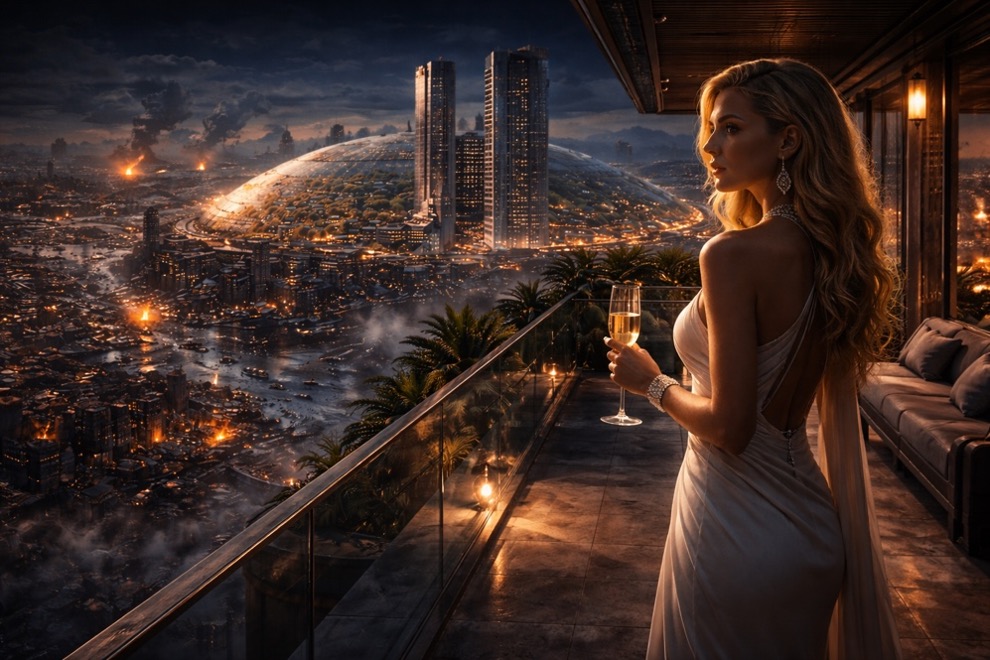
The air was perfect inside the Arcadia District, an island of wealth floating above the drowned ruins of the old world. The district's skyline gleamed, a dazzling array of glass towers and solar-paneled estates, suspended on towering platforms in the sky, while the rest of the planet choked beneath thick clouds of ash, smoke, and relentless heat.
Inside the compound, life was normal—or at least, normal for them.
Emilia Voss, CEO of Voss Industries, sat in her penthouse, gazing out over the city. She had lived through the rise of the global crisis, but she was far removed from the wreckage now. The world below her had collapsed, cities burned, oceans consumed entire coastlines, but here, life was safe, controlled, and tailored to her every need.
Her life, a pristine model of wealth and excess, was built upon the backs of the millions who had been left to fend for themselves in the death zones below. Areas that used to be thriving metropolises were now nothing more than barren wastelands, plagued by extreme heat, water scarcity, and violent storms that had turned the world into an unrecognizable landscape.
But here, in Arcadia, every element was artificial: climate-controlled weather systems, recycled air, genetically modified crops grown in vertical farms. The rich had created their own ecosystem, untouched by the chaos, a place where nature was curated and engineered.
Emilia sipped a glass of lab-grown wine, its taste as impeccable as the luxury skinsuit that adjusted to her body temperature without her having to move. Technology had moved past mere survival; it had become a tool of complete domination over the human body, mind, and environment.
“Ready for the summit, Mrs. Voss?” came a voice from the door. It was Adrian, her personal assistant, always just a step behind her. He was impeccably dressed in a white suit that shimmered with light, his face polished, like the rest of the elite who lived in Arcadia.
“Just about,” Emilia responded, her voice cold as she stood and walked towards the elevator that would take her to the Cultural Preservation Summit on the 55th floor.
“Remember, the others have their eyes on the carbon offset quotas,” Adrian reminded her. “They’ll want something substantial from you.”
Emilia didn’t need reminding. The carbon credit market had become the new currency for the rich. The collapse of the environment had led to the creation of climate equities, where the elites bought up massive chunks of carbon credits, hoarding them like gold, while the rest of the world was suffocated by the very pollution they had profited from.
The Summit Room was stark and sterile, the long conference table gleaming under the dim light. Around it sat the other key figures of Arcadia—billionaire industrialists, former politicians, media moguls, and the influencers who now dictated reality from behind layers of virtual screens.
They spoke little of the outside world. To them, it was a forgotten thing, a past life. They were more concerned with their projects and their investments—the growth of their artificial islands and their resource-mining operations on what remained of the uninhabitable zones.
Emilia took her seat at the head of the table.
"The situation is worsening, as you all know," said Victor Kane, a media mogul and fellow member of the Elite. His fingers traced the edge of his digital tablet. “Our private sectors are untouchable, but I don’t think we’ve done enough to secure our long-term hold over the remaining resources. The people below us are starting to form... resistance factions. They are coming for the last parts of the earth we hold.”
Emilia’s gaze tightened. She was well aware of the growing unrest among the lower classes—what they now called the "Groundborn". They had once been called citizens, but now they were little more than subhuman scavengers, living in constant struggle for survival. As Arcadia’s climate-controlled sanctuaries flourished, the masses below rotted. Food was grown in vats, water came from expensive desalination processes, and heat-resistant housing was sold for a premium. Yet, none of this extended to the world outside the skybound walls of Arcadia.
The Groundborn had begun to fight back, launching sporadic attacks on transport systems and underground bunkers where the last fresh water was being hoarded. Some had begun organizing, but they were too disorganized to ever truly challenge the elites. Still, the fear that the scalability of these rebellions might turn into a serious threat to their comfortable existence was growing.
“We need to act before they get organized,” Victor continued. “We need a cleanse.”
A murmur ran around the table. A cleanse. The kind of operations that were usually carried out with precision and impunity, wiping out settlements in the name of peacekeeping, resource distribution, or preserving law.
Emilia leaned forward. Her fingers drummed lightly on the table, a methodical motion.
“We don’t need a cleanse,” she said calmly. “What we need is better public relations. These ‘rebellions’ are not a threat yet, they’re simply a mild inconvenience. The real problem is the narrative.”
“The narrative?” Adrian echoed, confused.
“The Groundborn,” Emilia continued, “are making a name for themselves in the only way they know how: violence. They want to take control of the food sources.
They want equality. But the moment we start claiming that Arcadia is the last sanctuary for humanity, we have them right where we want them.”
She paused, her eyes glinting with the kind of cold logic that only the elite could afford.
“If we spin this correctly, we become their saviors. The world can’t function without us. The future will need our technology. We are the new evolution. The Groundborn will have to submit. It will be economically impossible for them to resist. If they want food, if they want water, we control all of it.”
The others around the table nodded, murmuring in agreement. The strategy was clear.
The elite had no intention of ending their reign. They would control everything: food, water, resources, and most importantly, history. If they didn’t hold the past, they would rewrite it.
Later that evening, as Emilia stood on her balcony, watching the city glitter below her, she reflected on the perfect order Arcadia had achieved. It had cost the world everything, but it had worked. The elite had become gods, isolated from the suffering, the suffocating heat, and the apocalyptic collapse that had befallen the Earth.
But she knew, somewhere deep within her, that even Arcadia’s perfect existence had an expiry date. Eventually, the world would begin to forget them. Eventually, the Groundborn would take back the Earth, and they would erase the legacy of Arcadia. No one would ever remember them as saviors—they would only be conquerors in history’s eyes.
But that was a story for another day. For now, Emilia could enjoy her glass of lab-grown wine, the air conditioning, and the certainty that she, at least, would never go hungry.
| Prompts and Collaboration with ChatGPT |
|---|
The Last Eden was created through prompting with generative AI to explore how extreme climate change might shape elite behavior in a 5°C future. I helped the output by elaborating on the tone and focusing on moral distance and power, using AI as a tool for experimentation rather than authorship.
| Home | AI Writing | More Cli Fi Stories | About Us |