
|
|
| Silence Above the Earth |
|---|
| Lucy Wadaga & ChatGPT |
|---|
From orbit, Earth was still beautiful. That was the cruelest part.
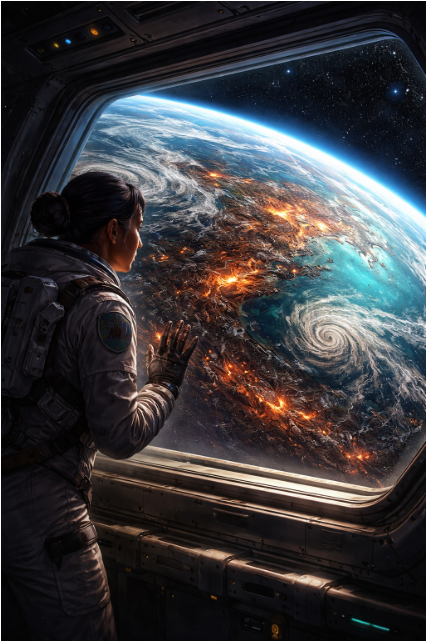
Commander Aisha Rahman floated by the observation window of Station Kepler-9, watching the planet roll beneath her. The oceans glowed an unnatural turquoise, heated from pole to pole. No white at the top. No white at the bottom. The ice caps were gone — not thinning, not retreating — gone. At six degrees above pre-industrial, the planet had crossed into a new state. The scientists called it a hothouse Earth.
Aisha tapped her tablet.
Surface temperature anomalies: +6.2 °C
Atmospheric CO₂: 1,250 ppm
Methane release: accelerating
She used to be a climate physicist before becoming an astronaut. Now her job was to watch a dying world and report what was left.
Below her, continents looked scorched. The Amazon — once a dense emerald lung — was now a rust-colored smear. The Sahara had marched south and east, swallowing nations. Australia’s interior glowed like a kiln. Fires traced bright scars across the night side of the planet.
But it was the oceans that terrified her most.
They no longer moved gently. From space, she could see superstorms spiraling across entire basins, fed by water so warm it powered systems larger than anything in recorded history. Cyclones merged. Storms bred storms. The seas had become engines.
A message blinked in her headset:
Last transmission from Surface Node 12 received.
She opened the file. A woman’s face filled the screen — sunburned, exhausted, eyes bright with fear.
“If anyone is still up there,” the woman said, “we’re running out of clean water. The heat’s too much. We can’t grow food. We can’t stay. Tell them we tried.”
The message cut to static.
Aisha closed her eyes. At six degrees, feedback loops ruled the planet. Permafrost had released its ancient carbon. Forests no longer absorbed CO₂ — they burned. The oceans, once humanity’s heat sink, now belched warmth back into the sky. Every system that once stabilized Earth had turned against it.
She floated back to the window. The Earth turned slowly below her, glowing, burning, alive with chaos.
“Still beautiful,” her crewmate whispered behind her.
“Yes,” Aisha said.
“But not for us.”
Kepler-9’s mission was almost over. The station would soon retreat farther into orbit, then beyond — a human seed drifting away from its birthplace. The surface was no longer safe. Not for long.
Aisha recorded her final log:
“To whoever finds this: Earth was once gentle. It had snow and forests and coral and rain that didn’t burn your skin. We knew what was happening. We had the data. We had the warnings. We waited too long.”
She sent the file. Then she watched her planet — her only home — turn beneath her, blue and burning in the dark.
| Prompts and Collaboration with ChatGPT |
|---|
For this story, I asked ChatGPT to create a story from the perspective of an astronaut observing the 6 degree world below. I changed the title, edited a few paragraphs, played around with the dialogue and tone, and gave the main character somewhat of a backstory until I was happy with how the story turned out.
| Home | AI Writing | More Cli Fi Stories | About Us |